

Dubsado vs HoneyBook: Which CRM Is Actually Better for Creative Entrepreneurs?
March 10, 2026
If you’ve been going back and forth between HoneyBook vs Dubsado for longer than you’d like to admit, I’m here to end that spiral.
If I know you, you’ve been asking yourself things like:
Which CRM is better?
Is Dubsado more customizable?
Is HoneyBook easier?
Am I going to regret picking the wrong one?
Here’s the honest truth. The Dubsado vs HoneyBook debate isn’t about which platform is “better.” It’s about which one you’ll actually use without wanting to throw your laptop.
I’m Karly, and after 5 years as a certified HoneyBook Pro and HoneyBook expert, I’ve seen what works in real businesses. Before we break this down, if you already know you’re leaning toward HoneyBook but don’t want to DIY your setup, I offer a full HoneyBook setup service where I handle the entire backend for you. You stay in your zone. I build the systems. Or hire me for my HoneyBook intensive service where we tackle the issues together.
Now let’s dig into the real Dubsado vs HoneyBook comparison.

HoneyBook vs Dubsado at a Glance
When people search Dubsado vs HoneyBook, they usually want the quick rundown first. So here it is.
HoneyBook
- Clean interface
- Simple navigation
- Built-in templates
- Strong client portal experience
- Easier learning curve
- Designed for creative service providers
Dubsado
- Highly customizable
- More complex workflows
- More manual setup
- Greater flexibility
- Steeper learning curve
That’s the surface-level answer. But surface-level answers don’t help when you’re building systems for creative entrepreneurs that actually need to work.
So let’s go deeper.
Not totally sure what HoneyBook even is? Before you decide between HoneyBook vs Dubsado, read this breakdown of what HoneyBook does, who it’s for, and whether it actually makes sense for your business.
The Biggest Differences of Dubsado vs HoneyBook
Both platforms let you send proposals, collect payments, manage projects, and automate follow-ups. On paper, they look nearly identical. But in practice? They operate very differently.
HoneyBook is opinionated. It was built with a specific workflow in mind: inquiry → proposal → contract → payment → project → offboarding. That structure is baked into everything. The interface, the pipeline, the way files work… it all assumes you run a client-based service business, and it guides you accordingly.
Dubsado is a blank canvas. It gives you a collection of powerful building blocks (like forms, workflows, email triggers, schedulers, payment plans), but it expects you to wire them together yourself. There’s no assumed structure. You design the whole thing from scratch.
This is why people who love Dubsado really love it, and why people who hate it want to throw their laptop out the window. It rewards systems thinkers who enjoy building. It punishes everyone else.
If you’re comparing Dubsado vs HoneyBook strictly on ease of use, HoneyBook wins for most creative service providers.
Still confused about how HoneyBook actually works? I break it down step by step and show you why it feels overwhelming at first and how to simplify it fast. If you’ve ever Googled “how does HoneyBook work,” start here.
Workflows and Automations Compared
Now let’s talk about business automation workflow (because let’s be honest, when it comes to choosing a CRM, chances are you are looking for something that’s going to free up a lot of your admin time and make your life easier). Both platforms offer workflows and automations. And both can send emails, reminders, invoices, contracts.
In Dubsado, you build workflow sequences from scratch. You define every trigger, every action, every condition. You can create incredibly complex, branching automations that respond differently based on what a client does. It’s powerful. But it’s also a part-time job to build and maintain.
In HoneyBook, automations are more structured. You set up a sequence (send this email, then wait 2 days, then send the invoice), and it runs. It’s not as flexible, but it’s significantly faster to build and much harder to accidentally break. The newer Automation 2.0 update added conditional logic, which closed a lot of the gap with Dubsado.
And most business creatives don’t need 47 custom triggers. They need:
- Auto reminders
- Proposal follow-ups
- Booking schedulers
- Payment schedules
- Onboarding sequences
- Offboarding emails
If you’re a solo service provider who needs automations to work, not automations to admire, HoneyBook is the more practical choice.
HoneyBook handles that beautifully when it’s set up correctly.
And that’s the key. Correctly.

The Client Experience Is Not Created Equal
Your CRM isn’t just for you. It’s for your clients.
In the Dubsado vs HoneyBook comparison, this is where HoneyBook really shines, and it mostly comes down to one feature: Smart Files.
Smart Files let you combine your proposal, contract, and invoice into a single, beautifully structured document. Instead of sending three separate things at three different times and hoping your client finds all of them, you send one link. The client reads your proposal, signs the contract, and pays the retainer all in one sitting. No account creation, no portal login, and most importantly, no hunting through their inbox for the right email.
That flow matters more than people realize. Every extra step between “I want to book you” and “I’m officially booked” is a place where a client can hesitate, get distracted, or talk themselves out of it. Smart Files collapse that gap dramatically.
You can also build Smart Files to match your brand (your colors, your fonts, your imagery) so the experience feels like a natural extension of your website rather than a detour into generic software. For creative service providers whose brand is a big part of why clients choose them, that consistency reinforces that you’re the right choice.
Dubsado’s client portal works, but it asks more of the client. They get their own login, navigate separate sections for contracts, invoices, and files, and the overall experience tends to feel more administrative than intentional. It’s functional but it’s not as easy to navigate for the average consumer. For a service business that’s competing on experience, where the feeling of working with you is part of what you’re selling, that gap matters more than most people account for.
Your CRM should sell for you, not just store contracts. I walk through how to build HoneyBook systems for creative entrepreneurs that turn inquiries into booked clients without constant follow-up.
Customization: A Feature and a Trap In the Dubsado vs HoneyBook Debate
This is the heart of Dubsado vs HoneyBook.
Dubsado wins on raw customization. You can style your forms, brand every touchpoint, build custom lead capture flows, add custom code to your onboarding forms, and design workflows that rival what an agency might build in enterprise software. If you have the time and the inclination, Dubsado can do almost anything.
But here’s what I’ve seen after working with 200+ business owners: most people don’t need that level of customization. They need a system that runs. The more options you have, the longer it takes to make decisions, the more ways there are to set something up wrong, and the harder it is to hand off to a VA or troubleshoot when something breaks.
Pricing Differences and Long-Term Cost
Now let’s talk real numbers. Because when people search Dubsado vs HoneyBook, pricing is usually the tipping point.
On the surface, they’re in the same ballpark. But the details matter.
HoneyBook Pricing
HoneyBook currently offers three main plans when billed annually:
Starter – $29/month (billed yearly)
- Unlimited clients and projects
- Invoices and payments
- Proposals and contracts
- Client portal
- Calendar
- Basic reports
- Up to 2 live lead forms
- HoneyBook AI
Essentials – $36.75/month (billed yearly)
- Everything in Starter
- Scheduler
- Automations
- QuickBooks Online integration
- Up to 2 team members
- Up to 10 live lead forms
- SMS reminders
- Standard reports
- Remove “Powered by HoneyBook”
Premium – $81.75/month (billed yearly)
- Unlimited team members
- Priority support
- Multiple companies
- Advanced reports
- Unlimited live lead forms
- HoneyBook AI
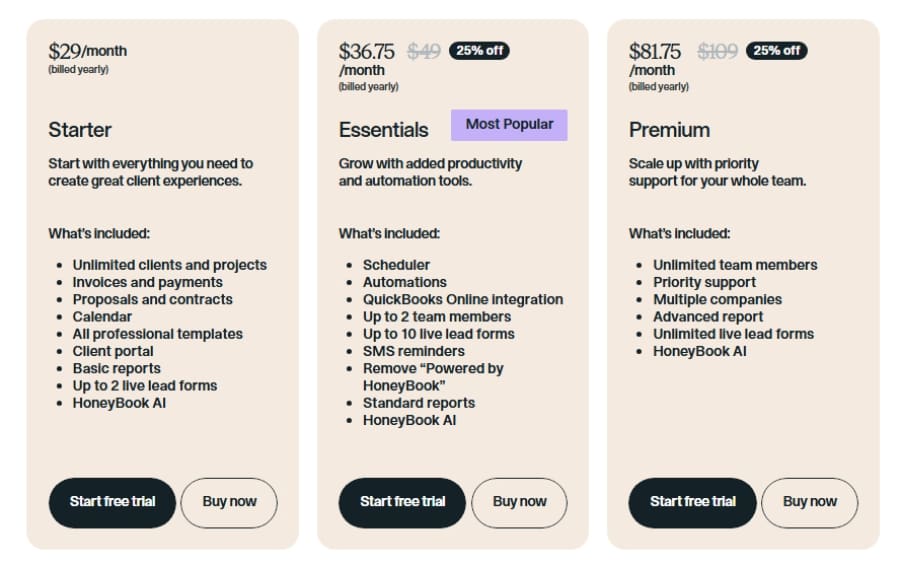
If you’re a solo creative service provider, most of my clients land in Essentials. That’s where you unlock the real power. Automations. Scheduler. Integrations. That’s when HoneyBook actually works for you instead of just storing contracts.
Now let’s compare that to Dubsado.
Dubsado Pricing
Dubsado keeps it simple with two main tiers:
Starter – $35/month
- Unlimited projects and clients
- Invoicing and payment plans
- Form and email templates
Premier – $55/month
- Everything in Starter
- Scheduling
- Automated workflows
- Public proposals
- Multiple lead captures at once
- Zapier integration
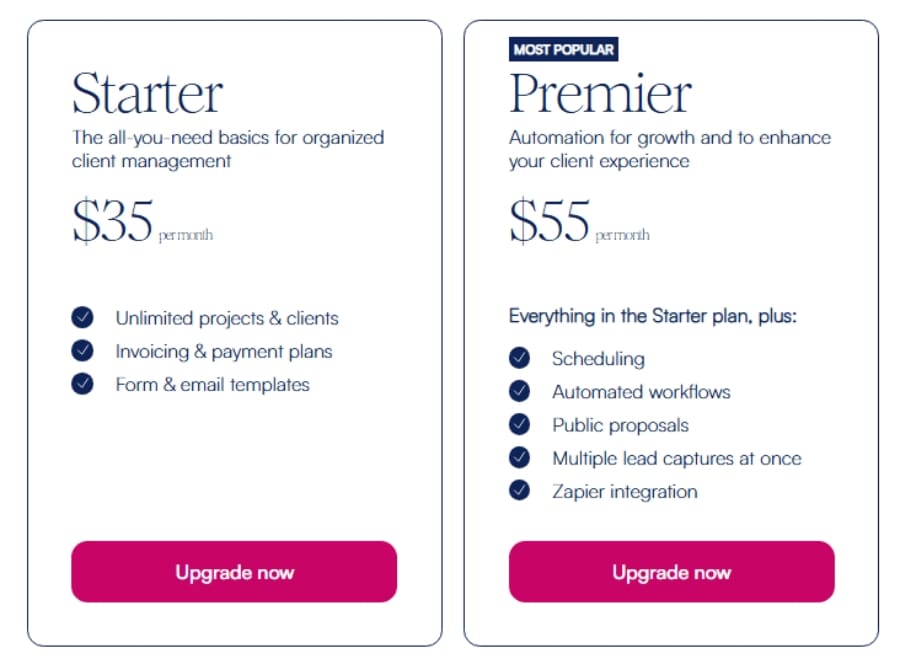
Right away, when people compare Dubsado vs HoneyBook, they zoom in on the monthly price tag.
But here’s what I always tell clients.
The monthly fee is not the full cost.
The real cost is:
- Time building everything from scratch
- Time troubleshooting
- Time figuring out workflows
- Lost leads if your automations break
- Energy spent learning your CRM instead of selling and serving
I’ve worked with business creatives who spent weeks inside Dubsado building complex workflows. Then they came to me exhausted.
On the flip side, I’ve seen messy HoneyBook accounts too. Because no matter which side of the Dubsado vs HoneyBook debate you’re on, bad setup equals bad experience.
And that’s why pricing alone shouldn’t decide this.
If you’re comparing Dubsado vs HoneyBook purely by subscription cost, you’re missing the part that actually matters.
You’re not buying software.
You’re buying:
- Time (because time IS money).
- Clarity.
- Smoother systems for creative entrepreneurs.
And that return is worth a lot more than “saving” a couple bucks a month.
Which CRM Is Better for Creative Service Providers?
Choose Dubsado if: You genuinely enjoy building systems, have the time to invest in a complex setup, and want maximum flexibility in how your workflows are structured. It’s a great platform if you’ll use what it’s capable of.
Choose HoneyBook if: You want a system that works without becoming your part-time hobby. If you’d rather focus on client work and need the backend to run quietly in the background then HoneyBook, set up well, does exactly that.
The platform matters less than most people think. A bad setup is a bad setup regardless of which software you’re paying for. What actually moves the needle is having a clear client journey, smart automations, and templates that reflect how you actually work.
That’s true in HoneyBook. That’s true in Dubsado. And that’s true whether you build it yourself or bring in someone who does this every day.
Already in HoneyBook but not sure if it’s set up right? Book a discovery call and we’ll figure out whether a HoneyBook Audit, 90-minute Strategy Call, or HoneyBook Intensive makes the most sense for you. Or if you’d rather hand it all off, my Full Setup handles everything.
Pros and Cons of Dubsado vs HoneyBook
HoneyBook Pros:
- Easier to learn
- Cleaner client experience
- Faster setup
- Strong automations
- Great for creative service providers
HoneyBook Cons:
- Less extreme customization
- Not ideal if you love heavy tech builds
Dubsado Pros:
- Deep customization
- Flexible forms and workflows
Dubsado Cons:
- Steeper learning curve
- More manual build time
- Can feel overwhelming

Conclusion: Stop Overthinking the Platform
If you’re stuck in the Dubsado vs HoneyBook spiral, here’s your permission slip to stop overthinking it.
Both platforms work. But one will likely feel lighter. And as someone who builds HoneyBook services and systems for creative entrepreneurs every week, I can tell you this.
You don’t need the most customizable CRM. You need the one you’ll actually use consistently.
👉 If you want it built right from day one, I offer a full HoneyBook setup service where I handle your workflows, automations, templates, and client portal from start to finish.
👉 And if you’re already inside HoneyBook but things feel messy, my HoneyBook support sessions are perfect for real-time troubleshooting and optimization.
Still unsure? Reach out and let’s talk it through.
The Dubsado vs HoneyBook debate doesn’t need to keep you stuck. I’ve got you.

After working inside 250+ HoneyBook accounts, I’ve seen every version of half-baked automation and piece-mealed templates imaginable.
I don’t get overwhelmed… I get to work.
When I’m off-duty, I practice what I preach. I enjoy my weekends laptop-free, my brunch unbothered, and my nights free from ‘just one more email.
I cannot stand when a brand markets itself as a luxury experience and then delivers onboarding that feels like opening a bag of chips and discovering it’s 80% air. If you’re going to look premium, you should operate premium (and I’m the one that can help you with that).
I want to talk about the parts of your business no one else talks about.
I’m Karly — The Systems Strategist Behind High-End Client Experiences
Around here, I help business owners close the gap between what they look like and what they operate like.
I’ll help you figure out what needs to be done and tackle it with you live, so you can move forward instead of wasting time trying to build systems that still don’t work.
We’ll focus on what matters most so you can skip the endless tutorials and guesswork and leave with a system that feels easier and more organized. You’ll walk away with real progress already made in your account.
If you want help improving things in HoneyBook, this is a focused two-hour session where we work through it together so you can move forward faster.
Intensive

I’ll design and build a custom HoneyBook setup for your business so every step feels effortless for both you and your clients — and finally runs the way you’ve always wanted it to.
From inquiry to offboarding, your client experience will reflect the same quality and care you put into your work. You’ll have a consistent process for all your clients that leads to fewer follow-ups, faster bookings, and more referrals.
Whether you’re brand new to HoneyBook or have used it for years, this is for you if you don’t have the time, patience, or desire to figure it out yourself.
Full Setup


